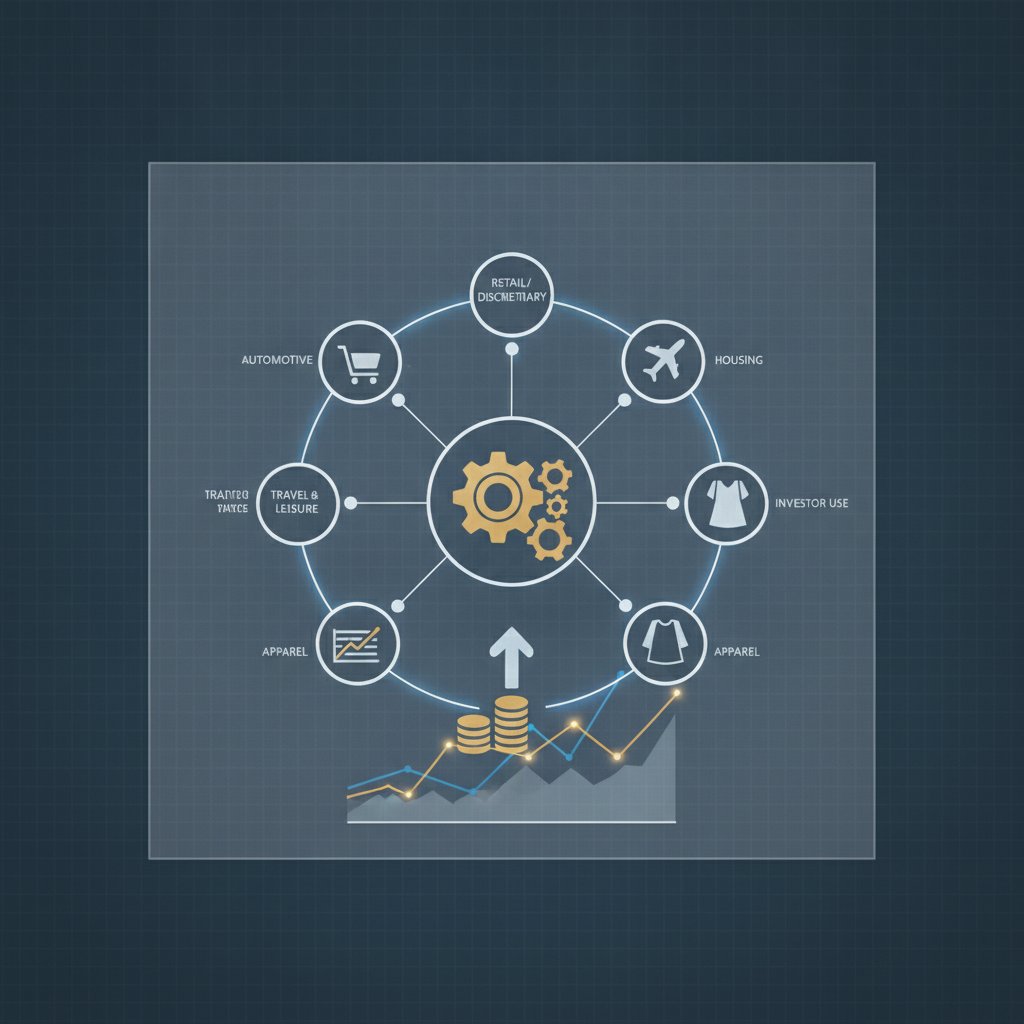
Consumer cyclical businesses are tied to spending that people can delay, reduce, or bring forward depending on the economy. When jobs are strong, credit is available, and households feel confident, these companies often see demand improve. When budgets tighten, they can feel the slowdown quickly.
That is the main difference from defensive areas such as consumer staples or utilities. Defensive sectors are built around everyday needs. Cyclical names depend more on optional purchases: a car, a vacation, new furniture, a restaurant meal, or a premium brand purchase.
A consumer cyclical stock is usually a company whose revenue and earnings depend heavily on discretionary consumer spending rather than everyday necessities. In practice, that means one stock in this sector is often judged by how sensitive its business is to confidence, credit, rates, and changes in household budgets.
What are consumer cyclical stocks?
Consumer cyclical stocks are shares of companies that sell non-essential goods and services to households, where demand rises and falls with the business cycle. Each name in this group is a company whose revenue, earnings, and share price tend to strengthen when the economy expands and weaken when it contracts, because the products involved are discretionary rather than necessities.
The wider “cyclical” label covers more than households alone. It also takes in industrials, financials, commodities, and transportation names whose fortunes track the economic cycle. The consumer-facing slice of that broader group is the household-demand part: cars, travel, dining out, apparel, and other purchases people can delay when money is tight.
The contrast is with consumer staples, sometimes called consumer non-cyclicals. Staples companies sell necessities such as basic food, household products, and utilities, so their demand holds up fairly steadily through downturns. Discretionary names depend on optional spending, which is exactly why they behave so differently across a recession.
How this part of the market is usually grouped
Sector labels can differ across indexes, screeners, and data vendors. The examples below are illustrative, and some companies may be grouped differently depending on the classification system. Still, most names in this area fall into a few familiar groups.
Autos and auto-related businesses
This group includes automakers, dealerships, parts retailers, and other companies linked to vehicle demand. Sales are often influenced by financing costs, replacement cycles, fuel prices, and consumer confidence.
Well-known examples include Ford, General Motors, Tesla, CarMax, and AutoZone.
Discretionary retail
These companies sell goods that are easier to postpone than groceries or household basics. Results often depend on traffic, promotions, inventory control, and how willing consumers are to spend beyond essentials.
Examples include Best Buy, Home Depot, Lowe’s, Nike, and TJX Companies.
Travel, leisure, and hospitality
Hotels, airlines, cruise operators, booking platforms, casinos, and live entertainment businesses usually move with travel demand and leisure budgets. This group can rebound sharply when spending recovers and weaken just as fast when consumers pull back.
Examples include Marriott, Hilton, Booking Holdings, Expedia, Delta Air Lines, and Carnival.
Housing and home-related spending
Some cyclical names are tied to home purchases, remodeling, furnishings, and renovation activity. Mortgage rates and housing turnover matter here, along with broader confidence in household finances.
Examples include D.R. Horton, Lennar, PulteGroup, Williams-Sonoma, Home Depot, and Lowe’s.
Media and entertainment
This bucket can include companies exposed to advertising demand, box office trends, theme-park attendance, ticket sales, and other forms of discretionary leisure spending.
Examples include Disney, Warner Bros. Discovery, and Live Nation.
Luxury and premium brands
Luxury demand is still cyclical, even if some brands serve higher-income customers. Tourism, wealth effects, and pricing power can all shape results.
Examples include Tapestry, Capri, and Ferrari.
Consumer cyclical companies by sub-sector
| Sub-sector | Example stocks |
|---|---|
| Autos and auto-related | Ford, General Motors, Tesla, CarMax, AutoZone |
| Discretionary retail | Best Buy, Home Depot, Lowe’s, Nike, TJX Companies |
| Travel, leisure, and hospitality | Marriott, Hilton, Booking Holdings, Expedia, Delta Air Lines, Carnival |
| Housing and home-related | D.R. Horton, Lennar, PulteGroup, Williams-Sonoma, Home Depot, Lowe’s |
| Media and entertainment | Disney, Warner Bros. Discovery, Live Nation |
| Luxury and premium brands | Tapestry, Capri, Ferrari |
What tends to drive revenue
The common thread is sensitivity to the consumer backdrop, but the drivers are not identical across the sector.
A few of the inputs investors usually watch are:
- employment and wage growth
- consumer confidence
- interest rates and access to credit
- housing activity
- travel demand
- promotional pressure
- input costs and freight costs
- inventory levels
An automaker and a hotel operator can both be cyclical while responding to very different pressures. Car demand is closely tied to financing conditions. A hotel chain is more exposed to leisure and business travel. A homebuilder can be especially sensitive to mortgage rates.
How investors usually evaluate these stocks
Headline sales growth is only the start. Because earnings can swing hard in this part of the market, investors often focus on how resilient demand and margins really are.
Demand sensitivity
The first question is how quickly customers step back when conditions soften. Big-ticket categories such as vehicles, furniture, and vacations are often among the first to be delayed.
Margins
Profitability matters because cyclical businesses can see earnings fall faster than revenue. Heavy discounting, weaker utilization, or higher input costs can pressure margins even before sales drop sharply.
Inventory discipline
Inventory is a major signal in retail, apparel, autos, and home goods. If stock builds too fast, markdowns can follow. That can hurt both gross margin and future ordering patterns.
Rates and financing conditions
Higher rates can weigh on several sub-sectors at once. They raise borrowing costs, reduce affordability, and make financed purchases less attractive.
Consumer spending quality
Investors also look at what is driving growth. Demand supported by repeat purchases or healthy unit growth is different from demand created by temporary promotions or one-off catch-up spending.
When these stocks tend to lead or lag
They often do well when the market starts to expect better growth, easier financial conditions, or a recovery in household spending. That can happen early in an expansion or during a rebound when expectations are still low.
They often struggle when recession risk rises, credit tightens, or consumers become more selective. In those periods, investors may prefer steadier sectors with less earnings volatility.
That does not mean every name moves together. Balance-sheet strength, brand power, cost control, and inventory management can create big differences inside the same sector.
How to research one on Trending Stocks
When researching a company in this part of the market, it helps to separate the sector backdrop from the stock-specific setup.
Start with the All Stock Research Ideas page to browse the site’s stock research index.
Then use the Methodology & Disclosures page for more detail on the site’s methodology and disclosures, including structured filters and backtesting.
The home page is also useful because it includes sections such as Best Recent Ideas and Model Ideas History. Those sections can help when reviewing current research alongside older published ideas.
When reviewing an individual name, a practical checklist is:
- which sub-sector it belongs to
- what usually drives its demand
- how exposed it is to rates or credit
- whether margins depend on discounting
- whether inventory or capacity looks stretched
- how the recent setup compares with past published ideas in similar areas
Main risks and common traps
These stocks can look cheap at the wrong point in the cycle. A low valuation multiple is not always a bargain if profits are near a high and likely to fall.
The main risks usually include:
- recession exposure
- sharp earnings swings
- margin pressure from discounting or weaker utilization
- inventory write-downs
- sensitivity to rates, credit, and housing activity
- valuation traps created by temporarily elevated earnings
That is why many investors look at where the business may be in its cycle, not just at the stock’s recent chart or current multiple.
When do cyclical stocks tend to outperform?
Because their sales follow the economy, these companies usually do their best work during expansions. Rising employment, higher wages, cheaper credit, and improving confidence all push households toward the big or optional purchases they depend on. A new car, a vacation, a kitchen remodel, or an upgraded phone gets easier to justify when a paycheck feels secure.
The reverse holds in a slowdown. When budgets tighten, discretionary purchases are among the first things people postpone, and revenues can fall quickly. Durable goods such as vehicles, furniture, and appliances tend to be the most sensitive, since they are large-ticket items that can wait. Fixed costs like stores, factories, hotels, and planes then weigh on margins when revenue drops, and discounting to move inventory can squeeze profits further.
A list by industry, with ticker symbols
Sector labels vary across indexes, screeners, and data vendors, so a company may sit in a different bucket depending on the classification. The names below are widely known public companies used here only to illustrate each sub-sector.
| Sub-sector | Company | Ticker |
|---|---|---|
| Automotive | Ford Motor Company | F |
| Automotive | General Motors | GM |
| Automotive | Tesla | TSLA |
| Automotive | CarMax | KMX |
| Automotive | AutoZone | AZO |
| Discretionary retail | Home Depot | HD |
| Discretionary retail | Lowe’s | LOW |
| Discretionary retail | Best Buy | BBY |
| Discretionary retail | TJX Companies | TJX |
| Discretionary retail | Target | TGT |
| Travel & hospitality | Marriott International | MAR |
| Travel & hospitality | Delta Air Lines | DAL |
| Travel & hospitality | Royal Caribbean | RCL |
| Travel & hospitality | Booking Holdings | BKNG |
| Apparel & footwear | Nike | NKE |
| Apparel & footwear | Lululemon | LULU |
| Apparel & footwear | Ralph Lauren | RL |
| Restaurants | McDonald’s | MCD |
| Restaurants | Starbucks | SBUX |
| Media & entertainment | Walt Disney | DIS |
Many of these are global brands, so their results reflect demand across several economies rather than one. Luxury names, along with travel and high-end leisure, lean heavily on higher-income households and the wealth effect, which is why they can hold up better than mass-market discretionary spending in some downturns.
How to screen these names
Because the sector rides the economic cycle, most people watch two layers at once: the macro backdrop and the individual company.
On the macro side, the common signals are GDP growth and industrial production, employment and wage data, consumer confidence indices, interest rates and credit conditions, and inflation. Rates matter twice over here, since they affect both financing costs on big-ticket purchases like cars and homes and the general appetite to borrow.
At the company level, it helps to look at how sensitive the business actually is to those swings: exposure to discretionary versus semi-essential spending, the mix of fixed versus variable costs, reliance on financing or credit revenue, brand pricing power, and inventory discipline. Two retailers in the same sub-sector can behave very differently through a cycle depending on how much of their revenue is truly optional.
See current trending ideas in this sector
The examples above are for context, not a shortlist. To see which discretionary names the model is publishing now as short-term research ideas, browse the full research directory, which lists every company by sector with its latest idea date and current result. The methodology page explains the structured filters and backtesting behind how those ideas are selected.
Research use only
Trending Stocks publishes research for general circulation. It does not provide individualized investment advice, and the same research process applies to all readers. Research content is for educational purposes only. Not investment advice. All decisions are your responsibility.
Disclaimer
This article is research published for general circulation and educational purposes only. It does not account for your objectives or financial situation and is not individualized investment advice. All investment decisions are your own responsibility.